
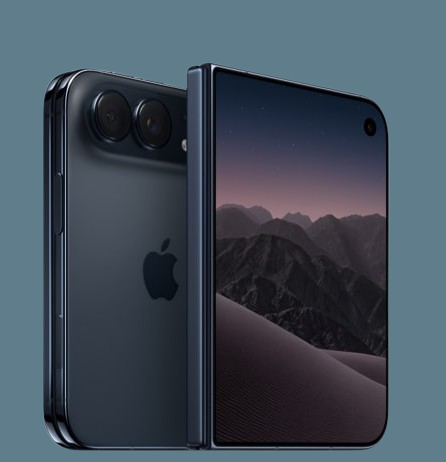

Apple has finally entered the foldable-phone era.
After years of watching Samsung, Google and other manufacturers experiment with folding smartphones, Apple has introduced the iPhone Duo, its first foldable iPhone and one of the most significant redesigns in the iPhone’s history.
The Duo isn’t simply an iPhone with a folding screen. Apple has redesigned the hardware, iOS experience, camera system, authentication, thermal architecture and multitasking experience around the foldable form factor.
With a 7.6-inch internal display, 5.4-inch outer display, A20 Pro chip, dual 48MP cameras, titanium construction, dual-battery architecture and up to 2TB of storage, the Duo is positioned as a premium device designed to combine the convenience of an iPhone with some of the productivity advantages of a small tablet.
Here’s everything you need to know.
What Is the iPhone Duo?
The iPhone Duo is Apple’s first foldable smartphone.
Rather than folding vertically like a traditional flip phone, it uses a book-style folding design. When closed, you use the 5.4-inch outer display much like a conventional smartphone. Open it, and the device expands into a 7.6-inch display.
Apple says the internal display is 50% larger than the display on the iPhone 18 Pro Max, making it the largest screen ever placed on an iPhone.
The concept is straightforward:
- Closed: compact smartphone
- Open: large-screen productivity and entertainment device
- Partially folded: hands-free viewing, photography and video calls
- Open and flat: multitasking with two applications side by side
This makes the Duo much more than a larger iPhone. Its purpose is to give users multiple ways of interacting with the same device.
iPhone Duo: Key Specifications at a Glance
| Feature | iPhone Duo |
|---|---|
| Form factor | Book-style foldable smartphone |
| Outer display | 5.4-inch Super Retina XDR |
| Inner display | 7.6-inch Super Retina XDR |
| Refresh rate | ProMotion |
| Peak brightness | Up to 3,000 nits outdoors |
| Processor | Apple A20 Pro |
| CPU | 6-core |
| GPU | 7-core |
| Neural Engine | Dual 16-core |
| Rear cameras | 48MP Fusion Main + 48MP Fusion Ultra Wide |
| Optical-quality zoom | Up to 2x |
| Front camera | 12MP Center Stage |
| Inner FaceTime camera | Under-display, 1080p |
| Video | Up to 4K at 120fps Dolby Vision |
| Storage | 256GB, 512GB, 1TB, 2TB |
| Biometrics | Touch ID |
| Operating system | iOS 27 |
| Connectivity | Wi-Fi 7, Bluetooth 6, 5G |
| Cellular | Dual eSIM |
| Charging | USB-C, MagSafe and Qi2 |
| MagSafe/Qi2 | Up to 25W |
| Water/dust resistance | IP68 |
| Frame | Grade 5 titanium |
| Colors | Star White, Night Sky |
| Starting price | $1,999 |
| Pre-orders | October 16, 2026 |
| General availability | October 23, 2026 |
1. The Foldable Display Is the Star of the Show
The biggest reason to buy the Duo is obviously its display.
Apple has equipped the phone with two Super Retina XDR displays.
The external display measures 5.4 inches, giving users a conventional phone experience when the device is folded.
Open the phone and the experience changes dramatically: the 7.6-inch internal display provides a much larger canvas for applications, video, games, documents and multitasking. AApple
Both displays include:
- ProMotion
- Always-On display
- Up to 3,000 nits peak outdoor brightness
- Super Retina XDR technology
- Matching aspect ratios
The matching aspect ratio is particularly important. Apple designed the displays so that content can transition between the outside and inside screens without feeling like you’re suddenly using two completely different devices.
The crease problem
One of the biggest complaints about foldable phones has traditionally been the visible crease.
Apple is attempting to address this with a custom nano-texture finish that reduces reflections and makes the crease less visually prominent.
The internal display also uses a multilayer construction, custom adhesives and additional structural materials designed to reduce stress on the folding panel.
Whether Apple’s approach proves more durable over several years is something only long-term ownership will reveal.
2. It’s Surprisingly Thin
When unfolded, Apple says the Duo is its thinnest iPhone ever, measuring approximately 5.2mm at its thinnest point.
When folded, however, it becomes substantially thicker because the two halves sit together.
The trade-off is familiar with foldables: you get a tablet-sized display in a pocketable device, but you sacrifice some thickness and weight compared with a traditional smartphone.
The Duo weighs about 254 grams, which makes it heavier than the iPhone 17 Pro Max and noticeably heavier than many conventional flagship phones.
That’s an important consideration.
The Duo looks incredibly futuristic, but it isn’t necessarily the best choice if your priority is having the lightest possible phone.
3. Titanium Construction and a More Serious Approach to Durability
Apple has built the Duo around a Grade 5 titanium frame.
The hinge is also a major engineering project. Apple says the precision hinge contains more than 100 components and is designed to provide controlled movement while supporting the center of the display.
The device also incorporates:
- Ceramic Shield 2 on the outer display
- Ceramic Shield on the back
- A scratch-resistant internal display coating
- Nano-textured internal display layer
- Reinforced internal structure
- IP68 water and dust resistance
Apple claims Ceramic Shield 2 offers three times better scratch resistance than the previous generation.
That IP68 rating is particularly noteworthy because durability and water resistance have historically been concerns for foldable devices.
Nevertheless, an IP68 rating doesn’t make the folding screen indestructible. The internal display remains a more complicated piece of hardware than the fixed glass panel on a conventional iPhone.
4. A20 Pro: The Performance Powerhouse
The iPhone Duo is powered by Apple’s new A20 Pro chip.
This is the same processor family used in the iPhone 18 Pro models, giving the Duo flagship-level processing power rather than treating it as a compromise device.
The A20 Pro features:
- 6-core CPU
- 7-core GPU
- Dual 16-core Neural Engine
- 2nm manufacturing technology
- Increased memory bandwidth
- Dedicated thermal management
Apple says the CPU is up to 20% faster than the A19 Pro, while the GPU is up to 40% faster and more power efficient. Apple also says the new Neural Engine delivers twice the compute capability for on-device AI workloads.
Why thermal management matters
Foldable phones have a particular challenge: there is less room inside for conventional cooling solutions.
Apple therefore paired the A20 Pro with a custom vapor chamber.
The company claims this allows the Duo to sustain performance for demanding activities such as:
- High-frame-rate gaming
- AI processing
- Video editing
- Multitasking
- Long-duration intensive workloads
Apple says the Duo can deliver up to 35% better sustained performance than the iPhone 17 Pro.
That’s potentially more important than peak benchmark scores because foldable users are likely to take advantage of the large display for longer and more demanding sessions.
5. The Camera System: Two 48MP Cameras
Apple has equipped the Duo with a 48MP Dual Fusion camera system.
It consists of:
48MP Fusion Main
The primary camera features:
- 48MP resolution
- Sensor-shift optical image stabilization
- Zero shutter lag
- Improved computational photography
- Low-light improvements
- Optical-quality 2x telephoto capability
Apple describes the main camera as effectively offering two focal-length experiences, with 1x and 2x shooting.
48MP Fusion Ultra Wide
The second camera is a 48MP ultra-wide camera.
It provides:
- Wider perspectives
- Macro photography
- High-resolution images
- More flexibility for landscapes and group shots
Together, the cameras cover 0.5x, 1x and 2x perspectives.
This is impressive, but it also highlights one of the Duo’s biggest compromises.
There’s no dedicated telephoto camera
Unlike Apple’s Pro models, the Duo doesn’t have a dedicated long-range telephoto camera.
That means serious mobile photographers may prefer the iPhone 18 Pro or Pro Max if long-distance zoom is important.
Apple is essentially betting that computational photography and the high-resolution main sensor can provide a good enough 2x experience for most users.
6. A Foldable Phone Designed Around Photography
Here’s where the folding design becomes genuinely useful.
The Duo can use its outer display as a preview screen while taking photographs with the rear cameras.
That means you can essentially use the much better rear cameras to take selfies while seeing yourself on the external screen.
Apple also introduces Duo Preview, which lets subjects see the live camera preview.
There’s also Smart Take, which uses on-device AI to automatically capture photos when people are ready, and Kid Cue, which uses animations on the outer screen to encourage children to look toward the camera.
These aren’t simply software gimmicks. They’re examples of Apple designing camera features around the physical flexibility of a foldable phone.
7. Video Capabilities Are Extremely Serious
For video creators, the Duo is considerably more capable than its unconventional design might suggest.
The main camera can record:
4K video at up to 120fps with Dolby Vision.
It also supports:
- Cinematic effects
- Audio Mix
- 4K Dolby Vision time-lapse
- Improved voice isolation
- Slow-motion recording
- Flexible hands-free shooting
The folding design also means you can partially fold the phone and use it like a miniature stand without necessarily needing a traditional tripod
For creators, travelers and social-media users, this could be one of the Duo’s most practical advantages.
8. Apple Finally Embraces Multitasking on the iPhone
For years, the iPhone’s large-screen multitasking capabilities lagged behind the iPad.
The Duo changes that.
With iOS 27, users can open two applications side by side using Split View.
For example, you could have:
- Safari + Notes
- Messages + Calendar
- YouTube + Safari
- Mail + Files
- ChatGPT + a document
- Two Safari windows
Apple also allows users to save pairs of applications for quick access.
This is arguably the feature that makes the Duo more than an expensive novelty.
A large 7.6-inch screen combined with two-app multitasking can make the phone considerably more useful for work.
9. iOS 27 Was Rebuilt for the Foldable Form Factor
Apple isn’t simply running standard iOS on a bigger display.
iOS 27 introduces a variety of interface changes specifically designed for the Duo.
The system can automatically respond to:
- Folding and unfolding
- Different viewing orientations
- Switching between displays
- Split-screen multitasking
- Hands-free positioning
The Home Screen, Dock and navigation controls have also been redesigned to make better use of the expanded screen.
This software integration could ultimately be Apple’s biggest advantage over Android foldables.
Apple controls the processor, hardware, operating system and major applications, allowing it to optimize the entire experience as one product.
10. Apple Pencil Support
Here’s an unexpected feature: Apple Pencil support.
Apple says the Duo will support the USB-C Apple Pencil later in 2026.
That means users can use the large internal screen for:
- Handwritten notes
- Sketching
- Marking up documents
- Annotating PDFs
- Creative work
This is potentially a major differentiator.
The Duo isn’t replacing an iPad, but it brings some tablet-style functionality into a smartphone that you can fold and put into your pocket.
11. Touch ID Makes a Comeback
Perhaps one of the strangest decisions is Apple’s removal of Face ID.
Instead, the Duo uses Touch ID integrated into the side button.
This presumably allows Apple to save internal space that would otherwise be required for Face ID hardware.
The advantage is that Touch ID works whether the phone is open or closed.
But for existing iPhone users accustomed to Face ID, this could initially feel like a step backward.
12. Battery Life: Dual Batteries
Foldable phones create a battery challenge because the internal space is divided between two halves.
Apple addresses this with a dual-battery system, placing a battery on each side of the device.
Apple claims:
- Up to 31 hours of video playback using the inner display
- Up to 44 hours of video playback using the outer display
- Up to 24 hours of usage when both displays are used equally
The device supports fast charging, reaching up to 50% in around 20 minutes under Apple’s specified charging conditions.
Wireless charging supports up to 25W with MagSafe or Qi2.
Actual battery life, of course, will vary considerably depending on whether you’re gaming, using cellular data, recording video or spending most of your time on the larger internal display.
13. Connectivity Is Completely Modern
The Duo is equipped with Apple’s latest connectivity hardware.
It supports:
- 5G
- Wi-Fi 7
- Bluetooth 6
- Thread
- GPS and multiple positioning systems
- USB-C
- DisplayPort
- USB 3 up to 10Gbps
Apple has also introduced its new C2 cellular modem system and N1 wireless networking chip.
One significant change is the absence of a physical SIM card.
The Duo is eSIM-only, supporting two active eSIMs and storing eight or more eSIM profiles.
This is worth checking before purchasing, particularly for travelers and people whose carriers haven’t fully embraced eSIM.
14. Apple Intelligence and the New Siri
The Duo also arrives during Apple’s broader push into AI.
iOS 27 introduces the next generation of Apple’s AI capabilities, including the new Siri AI.
Apple says Siri can use:
- Personal context
- On-screen awareness
- Conversational interactions
- AI writing assistance
- Image editing
- Visual understanding
- Cross-app actions
Apple continues to emphasize a combination of on-device processing and Private Cloud Compute for AI workloads where cloud processing is necessary.
The Duo’s large screen could make these features more useful because you can interact with Siri while simultaneously viewing another application.
15. Storage Options Are Huge
The iPhone Duo starts at 256GB but goes all the way to 2TB.
Available capacities are:
- 256GB
- 512GB
- 1TB
- 2TB
The 2TB configuration is particularly interesting for people who record large amounts of 4K video.
But it also pushes the cost of the device considerably higher.
iPhone Duo Price
The iPhone Duo starts at:
$1,999 for 256GB
Apple offers four storage configurations:
- 256GB — $1,999
- 512GB — $2,199
- 1TB — $2,599
- 2TB — $3,199
The Duo is therefore comfortably positioned in luxury-smartphone territory.
Apple also offers financing and leasing options in the U.S., including its Apple Upgrade program. Accessories aren’t cheap either. The official Duo Case costs $79, while the Duo Folio with Kickstand costs $129 in the U.S.And that’s before considering AppleCare, Apple Pencil and other accessories.